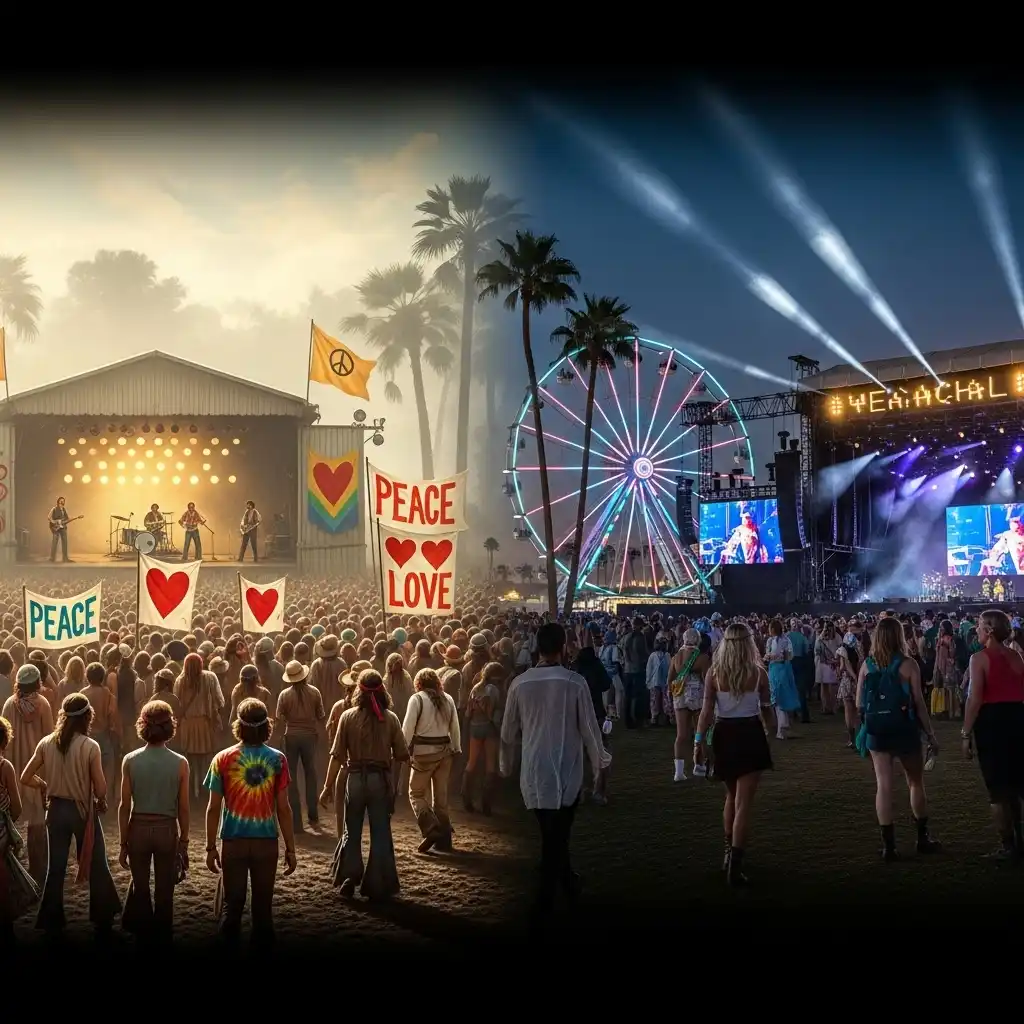
From a muddy farm in upstate New York to the manicured polo fields of Indio, California, music festivals have undergone one of the most dramatic transformations in entertainment history. What began as a countercultural statement against war and conformity has evolved into a multi-billion-dollar industry that shapes not just music, but fashion, technology, and social media culture. This is the story of how we got from "3 Days of Peace & Music" to the most Instagrammed weekend of the year.
The Genesis: Woodstock and the Birth of Festival Culture (1960s-70s)
The story begins on Max Yasgur's dairy farm in Bethel, New York, August 15-18, 1969. Woodstock wasn't just a concert – it was a cultural earthquake that redefined what live music could be. Originally expected to draw 50,000 people, the festival attracted an estimated 400,000, making it one of the largest gatherings in human history at that point.
What made Woodstock revolutionary wasn't just its size, but its ethos. In an era defined by the Vietnam War and social upheaval, the festival represented something unprecedented: a massive gathering focused on peace, music, and community. When Jimi Hendrix played his iconic version of "The Star-Spangled Banner" on Monday morning, he wasn't just performing – he was making a political statement that would echo through decades of festival culture.
☮️ Woodstock by the Numbers
The early 1970s saw festivals proliferate across America and Europe. Glastonbury began in 1970 as a small gathering inspired by hippie ideals, establishing the template for the multi-day camping experience.
The Dark Side: Altamont
Not all early festivals achieved Woodstock's idealism. The Altamont Free Concert later in 1969 descended into chaos, serving as a sobering reminder of the dangers of large unmanaged crowds. This tragedy would influence festival security and logistics for decades.
The Corporate Era: Festivals Go Mainstream (1980s-90s)
As the counterculture faded and MTV rose, festivals professionalized. In 1991, Lollapalooza revolutionized the concept by making it mobile. Created by Jane's Addiction frontman Perry Farrell, it traveled to cities across America, bringing alternative rock to the masses.
"Lollapalooza was never just about the music. It was about creating a community, a traveling city where people could be themselves and experience something extraordinary."
The Digital Revolution (2000s-2010s)
The new millennium brought seismic changes. Coachella launched in 1999 and eventually transformed from a rock festival into a global fashion and social media phenomenon.
Coachella's rise coincided with the explosion of social media. The festival's desert aesthetic became the perfect backdrop for the nascent Instagram era, shifting the focus from just hearing music to being seen at the event.
The EDM Explosion
Electronic Dance Music created a new category of festivals like Electric Daisy Carnival (EDC) and Tomorrowland. These events emphasized massive stage production, pyrotechnics, and a hedonistic, communal atmosphere that departed from the "band on a stage" tradition.
The Billion-Dollar Industry
Modern festivals are complex business operations. Here's a look at the economics of the world's biggest events.
| Festival | Attendance | Revenue (Est.) |
|---|---|---|
| Coachella | 250,000 | $114M |
| Glastonbury | 210,000 | $67M |
| Tomorrowland | 400,000 | $78M |
The Future: 2025 and Beyond
As we look ahead, festivals are prioritizing Sustainability and Immersive Tech. Coachella has invested heavily in solar energy, while Glastonbury has banned single-use plastics entirely.
But the core remains the same. Whether it's 1969 or 2029, the human desire to gather in a field, listen to loud music, and feel part of something bigger than oneself is timeless.
🔮 2030 Predictions
- 🎵 Holographic Legacies: Deceased icons touring via AI.
- 🌍 Climate Domes: Festivals in controlled biospheres.
- 🧠 Neural Audio: Direct brain-computer interface experiences.