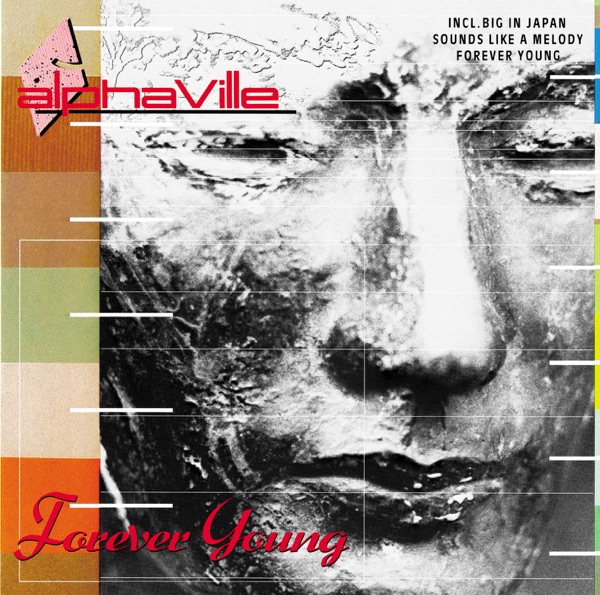
It is a song about the bomb
"Forever Young" has spent four decades being used as a farewell: graduations, last dances, memorials. That works, but it involves ignoring the words. The song was written in West Germany in 1984 — in the country that both blocs had spent thirty years planning to fight across — and its subject is not nostalgia. It is annihilation.
The opening verse establishes the setting in four short lines and then drops the question the whole song hangs on. The band are dancing, "hoping for the best but expecting the worst", watching the skies — and then: "Are you going to drop the bomb or not?" The line is delivered without any change of tone, which is exactly what makes it land. Nobody in the song is surprised by the question.
The chorus follows from it. "Let us die young or let us live forever" is not a menu of good options — it is what is left when the future has been taken off the table. "We don't have the power, but we never say never" is a line about being nineteen and having no say in whether the missiles fly. So the title works both ways at once: to be forever young is a fantasy of immortality and the literal condition of everyone who dies before they get old.
Later verses hold that double meaning open. "It's so hard to get old without a cause / I don't want to perish like a fading horse" is about wanting a life with meaning in it; "youth's like diamonds in the sun, and diamonds are forever" is the same thought turned into an advertisement, which is a fairly bleak joke. The music does not resolve the tension either — the arrangement is warm, major-key and consoling while the lyric is nothing of the kind, and that mismatch is why the song can be played at a funeral and a school disco without anyone noticing the problem.
The verse the label changed
The third verse most listeners know goes: "Can you imagine when this race is won / Turn our golden faces into the sun / Praising our leaders, we're getting in tune / The music's played by the madmen." It is the vaguest passage in the song, and there is a reason for that.
Marian Gold originally wrote it to evoke what he described as a "fascistic feeling" — the adoration of a crowd for its leader. In the original draft the lines ran "Can you imagine how we won the war / Little fascist lady she loves you so / Following her leader, she's getting in tune / The music's played by the madmen." Record executives pushed for a change, and the version everyone sings is the one they got.
Gold's own verdict on the replacement is worth quoting: he calls "turn our golden faces into the sun" the worst lyric in the song. That single edit is most of why the third verse feels like a mood rather than a statement — a specific image of crowds worshipping a leader was sanded down into something you could read as sunrise imagery, and most people do.
It was almost a dance record
"Forever Young" was not conceived as a ballad. The band intended an upbeat dance track and spent two days trying to record one, without ever being happy with it.
The decision that produced the song as it exists came from producer Andreas Budde, who told them to strip away almost everything — leaving the vocal and the synth pads — played it back, and said, "This is the song." What survives is close to the minimum a record can be and still be a record: a slow pad, a sparse programmed rhythm, and Marian Gold. The dance arrangement was not wasted; it was issued on the 12-inch as the six-minute "Special Dance Mix".
One more detail from the same sessions explains something odd about the vocal. Gold is not a native English speaker, and producer Colin Pearson coached his pronunciation. The band decided the word "dance" in the very first line should be sung the southern English way, /dɑːns/, so the record would sound British — and Gold sometimes forgets and reverts to the American /dæns/. Once you have noticed it you will hear it every time.
The song is in C major and runs 3:44. The production is credited to Colin Pearson, Wolfgang Loos and Andreas Budde; the music is by Gold with Bernhard Lloyd and Frank Mertens, the lyric by Gold alone.
The video in the asylum
The video is often described as a montage of youthful scenes cut with historical footage. It is nothing of the kind, and the real thing is much stranger.
Directed by Brian Ward and shot in England, it places the band performing in one of the halls of Holloway Sanatorium at Virginia Water, Surrey — a vast Victorian Gothic asylum. Around them, people of every age from children to the very old, dressed in ragged finery, wake up to watch the band, and then walk out through a glowing diamond-shaped portal.
The official music video, on Rhino's channel with the band's own.
It is a resurrection scene, in other words — the dead getting up and leaving — which fits a song about dying young considerably better than a nostalgia reel would.
A slow hit, then a slower one
"Forever Young" was the third single from the album, issued on 20 September 1984 after "Big in Japan" and "Sounds Like a Melody", and at first it was a regional success rather than a global one. It went to No. 1 in Sweden, No. 3 in Norway and Switzerland, No. 4 in West Germany and No. 13 in France.
Elsewhere it barely registered. In the United Kingdom it peaked at No. 98 — for what is now one of the best-known songs of the decade, a single week in the bottom three of the chart. In America it entered the Hot 100 at No. 95 in March 1985, climbed one place to No. 93, and fell off after four weeks; it did better on the dance floor, reaching No. 32 on the Club Play chart.
What happened instead is that American radio adopted it slowly and never let go. Reissued in 1988, it managed No. 65 on the Hot 100 across a fourteen-week run. And by 1987 it was topping listener retrospectives at stations including San Francisco's Live 105 and New Jersey's WPST — beating U2's "Pride (In the Name of Love)", New Order's "Blue Monday" and the Smiths' "How Soon Is Now?" — with Billboard calling it "the modern rock equivalent of 'Stairway to Heaven'".
Jay-Z, TikTok and a second life
Two things kept the song in circulation long after 1984. The first was Jay-Z's "Young Forever" (2009), which is frequently miscalled a cover. It is not one — it is a different song built on "Forever Young", and it introduced the hook to an audience that had never heard Alphaville.
The second was TikTok. In September 2024 the original recording went viral there, forty years after release, and on 5 October 2024 it reached No. 1 on the TikTok Billboard Top 50. Within weeks David Guetta and Ava Max had released a version with new verses, which Guetta had been road-testing through the summer at his Ibiza residency; the original inspired more than three million TikTok clips.
The certifications tell the same story. Almost every award this record holds was granted in 2024 and 2025 — Platinum in Germany, the UK, Italy, Denmark, New Zealand and Portugal, double Platinum in Canada and Spain — for a single that failed to reach the UK top 90 when it came out. As of May 2026 it has passed 1.2 billion streams on Spotify. It is a song that took four decades to become the hit everybody assumes it always was.
The lyrics
Read cold, the lyric is much odder than its reputation: a sandpit, a fading horse, diamonds, madmen playing the music, and one direct question about a nuclear weapon. It is a young man's poem about not expecting to get old, written by a band who then had to watch it become the song people play when they are happy.
Read the full lyrics We don't reproduce lyrics here — they're licensed. Genius has the full text with annotations.
Lyrics on Genius →