What the song is about
"I'm Yours" is a song about dropping your guard. The opening lines describe being disarmed — someone has got past whatever composure the singer was maintaining, and he has stopped pretending otherwise. Everything that follows is the consequence of that capitulation.
I won't hesitate no more, no more
What keeps it from being an ordinary love song is how quickly it stops being about a couple. By the second verse the address widens: the song is arguing for openness as a general policy, urging the listener to stop wasting time and to look at the world with fewer defences up. The "you" it surrenders to is at least as much life as it is a person.
The repeated title is the whole argument in two words. It is a declaration, but it is also a concession — the sound of someone deciding that resisting is more expensive than giving in. That double reading is why the song plays equally well as a wedding vow and as something closer to a shrug.
Three years to become a single
The song was not written for the album that made it famous. A demo version appeared in 2005 on a limited-edition EP called Extra Credit, released to promote Mraz's second album Mr. A–Z. He played it live for years before it was ever a single, and by the time it was properly released the audience already knew it.
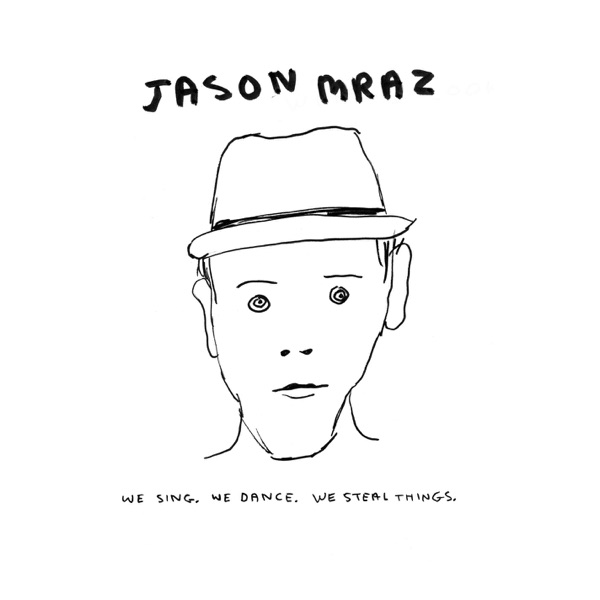
It finally arrived as a single on 12 February 2008, leading his third album, We Sing. We Dance. We Steal Things. Mraz wrote it alone and produced it with Martin Terefe.
That long incubation matters to how the record sounds. This is not a song being introduced to a room; it is a song that had been road-tested in front of audiences for three years, and the finished take keeps the loose, half-improvised phrasing of a performer who has stopped worrying about it. The famous vocal ad-libs are the residue of that.
The 76-week record
"I'm Yours" peaked at No. 6 on the Billboard Hot 100 — a good but unremarkable position. What was remarkable was how long it stayed. The song spent 76 weeks on the chart, breaking the all-time longevity record, which had been held by LeAnn Rimes' "How Do I Live" at 69 weeks.
Almost a year and a half of continuous charting is a different kind of achievement from a No. 1. It describes a record that never had a moment of mass saturation and instead kept picking up new listeners, week after week, largely through downloads — the song arrived exactly as the digital single was becoming the unit that counted.
The RIAA has since certified it 13× Platinum in the United States. Internationally it went to No. 1 in Sweden, Norway, New Zealand and Israel, and reached the top ten in Canada, Australia, Austria, Germany, Switzerland, Spain and Italy.
At the 51st Grammy Awards it was nominated for Song of the Year and Best Male Pop Vocal Performance. It won neither.
How it is built
The arrangement is deliberately thin: ukulele on top, a light reggae upstroke underneath, bass and brushed percussion holding a relaxed groove around 70 beats per minute. The song sits in B major and cycles a plain four-chord progression — B, F#, G#m, E — for essentially its whole length.
That progression is one of the most-used sequences in popular music, and using it undisguised is a choice rather than an oversight. Nothing in the harmony asks for attention, which leaves all of the available attention for the voice.
Open up your mind and see like me
The vocal is where the record actually happens. Mraz phrases behind the beat, slurs consonants, crowds syllables into half-rapped runs and then leaves whole bars empty. It is a performance built on timing rather than on range, and the production — clean, dry, close-miked, with the ukulele panned wide — is arranged to stay out of its way.
The video
There is an official music video, directed by Darren Doane and filmed in Hawaii in 2008 across Oahu and Kauai. It has no narrative: Mraz wanders through beaches, streets and roadside scenery with the ukulele, and the camera mostly just follows him. The looseness is the concept.
Official video, directed by Darren Doane, 2008 — shot on Oahu and Kauai. The 4K remaster on Jason Mraz's own channel.
The video has since passed 800 million views on YouTube, which is a larger number than the song's chart peak would ever have predicted — and consistent with everything else about this record, which has always done better over time than it did in any single week.
The lyrics
The writing is casual to the point of slang — contractions, filler words, phrases that sound improvised because several of them were. That register is doing real work: a song about dropping your defences would be undercut by a carefully polished lyric, so the language stays as unguarded as the sentiment.
The structure is equally relaxed. Verses run to unequal lengths, the chorus arrives when it feels like arriving, and the last minute is largely vocal improvisation over the same four chords. It is written the way it is meant to be heard: as someone who has stopped trying.