What the song is about
"This Must Be the Place (Naive Melody)" is a love song written by someone who had spent five albums avoiding writing one. Byrne has been unusually direct about it:
That's a love song made up almost completely of non sequiturs — David Byrne
He has said he had never written a straightforward love song before and was wary of it coming out "corny" or "stupid." The solution was to refuse to write the sentence he meant and instead assemble the song from statements that do not follow from one another: an observation, a piece of small talk, a flat declaration of fact. Almost nothing in the lyric connects logically to the line before it.
The effect is a song that arrives at tenderness sideways. "Home is where I want to be" is the plainest line in it, and it is immediately undercut. The central move of the song is that home turns out not to be a location at all — the singer is somewhere unfamiliar, without a map, and concludes that this must be the place because of who is standing in it.
Byrne called it "a real honest kind of love song," and that is the paradox worth sitting with: the honesty comes from the evasion. A lyric that stated the feeling outright would have been less convincing than one that keeps wandering away from it.
Why it is subtitled "Naive Melody"
The parenthetical is the most-asked question about this song, and the answer is technical rather than poetic. The band wrote and recorded it with the members playing instruments that were not theirs: Tina Weymouth played guitar instead of her usual bass, Jerry Harrison played synthesizer, and Byrne moved between guitar and synth.
Playing an unfamiliar instrument produces unfamiliar parts. The guitar and bass figures are ostinatos — short patterns repeated with almost no variation from beginning to end of the track. Byrne's explanation is that many professional musicians simply would not play a song written that way, because it declines every opportunity to develop. The melody is naive in the sense that a painting can be naive: made without the trained instinct to complicate it.
It is also the reason the song does not sound like the rest of Speaking in Tongues. The album is tight, funk-derived and highly worked; this track is four people slightly outside their competence, and it closes the record on a completely different emotional register.
The first album without Eno
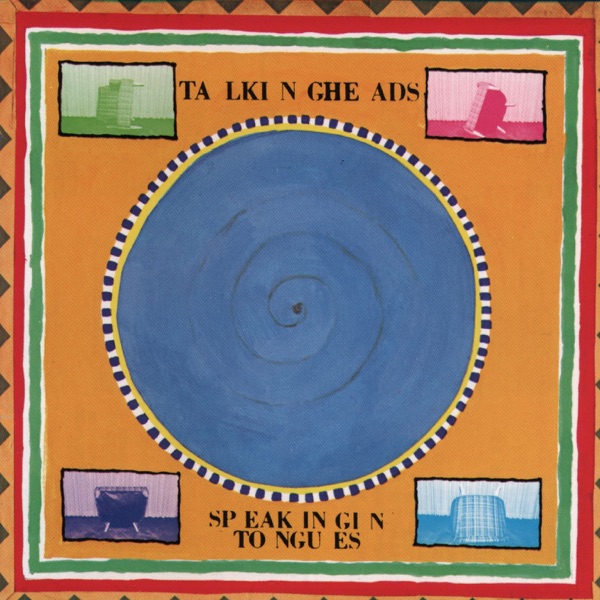
Speaking in Tongues was released on 1 June 1983 and "This Must Be the Place" followed as a single in November that year. It was the band's first album produced without Brian Eno, after three records together; Talking Heads produced it themselves.
The credits reflect the writing method. The words are Byrne's; the music is credited to all four members — Byrne, Chris Frantz, Jerry Harrison and Tina Weymouth — because it came out of the band playing together with their instruments shuffled.
The song's larger fame arrived a year later through Stop Making Sense, Jonathan Demme's concert film, where Byrne performs part of it dancing with a floor lamp. For a great many people that image is the song, and it has kept the track in circulation for four decades in a way its chart performance never would have.
It was not a hit
By the ordinary measures, "This Must Be the Place" failed. It reached No. 62 on the Billboard Hot 100 and No. 51 on the UK Singles Chart. A live version issued in 1986 managed No. 100 in the UK. Nothing about those numbers predicts the song's standing today.
What it had instead was college radio, alternative formats and, above all, time. Its reputation was built by repeated licensing to film and television, by cover versions, and by the concert film — a slow accumulation rather than a moment. The song is now probably the most widely loved thing Talking Heads recorded, and it is worth being precise about the fact that this happened long after 1983.
It is a clean example of a general point: chart position measures the velocity of a record in one particular quarter, and says very little about what a song will mean later.
How it is built
The track is essentially static. A repeating figure runs underneath almost the entire song, with the harmony barely moving; there is no bridge that resolves anything and no conventional verse-chorus architecture. What changes is density — parts are added and removed around a pattern that does not itself develop.
The instrument-swapping is audible if you listen for it. The guitar parts are simpler and more rhythmic than Byrne's usual playing, the synthesizer lines are held rather than played, and the whole texture is warmer and less angular than the band's records typically are. Chris Frantz's drumming is the one element doing its usual job, holding a steady, unfussy pattern that lets everything else stay still.
Home is where I want to be
Byrne's vocal is the other departure. He sings it — quietly, close to the microphone, without the yelping, strangulated delivery that characterises most of the band's catalogue. The performance is deliberately undramatic, and that restraint is what makes the song land as sincere rather than arch.
The video
There is an official music video, and it was directed by David Byrne himself. It shows the extended touring band watching home movies of themselves projected on a wall, before heading down into a small basement to play the song. The register is domestic and slightly awkward on purpose — it is a video about people in a room, which is exactly what the lyric is about.
Official video, 1983, directed by David Byrne — the official upload on the Talking Heads channel.
It should not be confused with the Stop Making Sense performance, which is a different piece of film entirely: Jonathan Demme's 1984 concert movie, and the source of the lamp.
The lyrics
Read on the page rather than heard, the lyric barely holds together. Lines contradict each other, the tense slips, and a sentence about not knowing anything is followed by one stating a preference about furniture. Byrne's description of it as non sequiturs is not modesty; it is an accurate technical account of how the text was assembled.
What holds it together is tone. Every one of those disconnected statements is delivered in the same calm, faintly bewildered voice, and the accumulation reads as a person too happy to be articulate. That is a hard thing to write on purpose, which is presumably why Byrne had to approach it by not writing it directly.